What Is Tax-Loss Harvesting and How Does It Work?

An investment loss is disappointing, but in a taxable account it may also create an opportunity to reduce taxes.

Tax-loss harvesting involves selling an investment at a loss and using that loss to offset capital gains from other investments. When the sale also supports the account holder’s long-term plan, the strategy can lower the current tax bill without allowing taxes to dictate the portfolio.
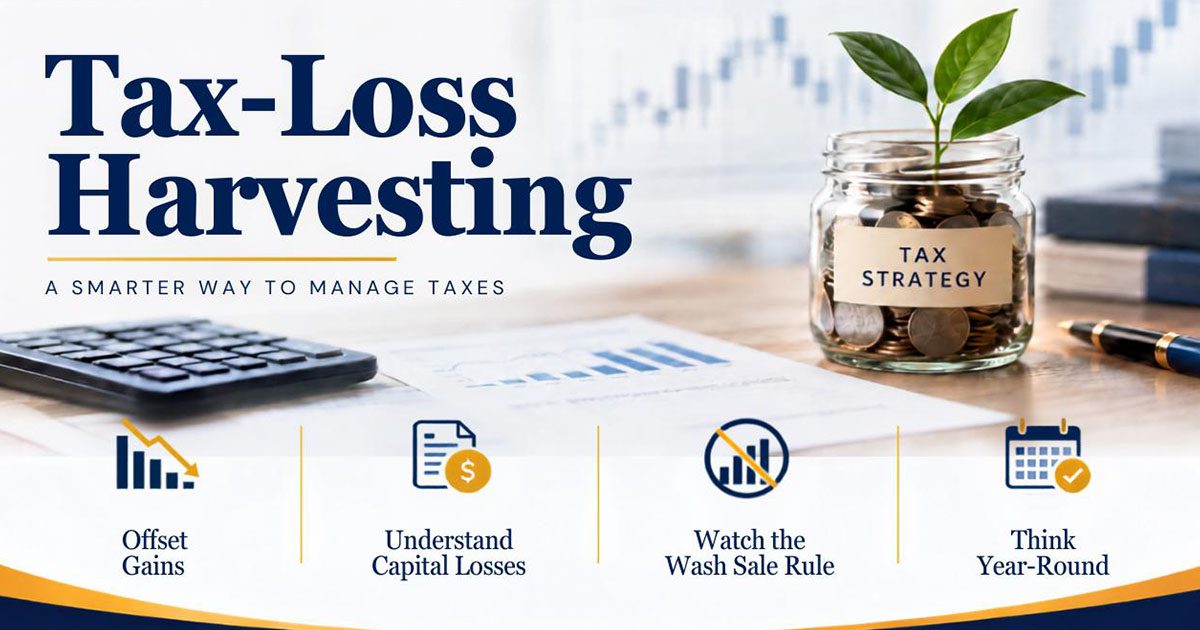
The sections below explain how capital losses offset gains, clarify the $3,000 limit, identify wash-sale risks across accounts, and outline when the strategy may fit a household’s broader plan.

A tax loss generally must be realized through a sale before it can affect current taxes. A decline in value that remains unsold is only a paper loss. Tax-loss harvesting therefore applies primarily to taxable accounts; losses in IRAs and other tax-deferred retirement accounts are not deducted in the same way.

Suppose an account has a $10,000 realized capital gain and another investment is sold for a $4,000 loss. The loss could reduce the taxable capital gain to $6,000. Although the investment loss remains real, using it intentionally may soften the gain’s tax impact.

The $3,000 annual limit is often misunderstood. Capital losses, including carryforwards, can offset capital gains without that limit. For example, $70,000 of loss carryforwards could offset an entire $50,000 capital gain. Of the remaining $20,000, up to $3,000 may be deducted against other taxable income, or $1,500 if married filing separately, with the balance carried forward.

One important rule can prevent the strategy from working as intended. Under the wash sale rule, a current loss generally cannot be claimed when the same or a substantially identical investment is purchased during the period that begins 30 days before the sale and ends 30 days after it. Including the sale date, the rule covers a 61-day window.

Wash-sale risk is not confined to the taxable account in which the loss is realized. Selling an investment for a loss in a taxable account and purchasing the same investment in an IRA or Roth IRA within 30 days can prevent the loss from being deducted. This can be especially costly because the disallowed loss is not added to the IRA’s cost basis and may be permanently lost. Automatic investments and dividend reinvestment should also be reviewed before making the sale.


Tax-loss harvesting may be worth considering when the tax benefit supports an investment decision that already makes sense, including the following situations:

  • The portfolio has realized capital gains and another investment is currently worth less than its cost.
  • An investment no longer fits the plan, the portfolio needs to be rebalanced, or a concentrated position needs to be reduced.
  • A market decline creates a loss that can be used while the account holder remains invested through a suitable replacement that is not substantially identical.

Even when tax-loss harvesting otherwise makes sense, the account holder should review recent and scheduled purchases across relevant accounts. A purchase in another taxable account or an account owned by their spouse can also create a wash sale.

Charitable giving may offer another way to manage capital gains. A highly appreciated investment may be donated directly rather than sold to generate cash for the gift. Depending on the circumstances, this may avoid realizing the gain and provide a charitable deduction. Tax-loss harvesting offsets realized gains; donating appreciated investments may avoid realizing them. Evaluating both can support a coordinated tax plan.

Tax-loss harvesting should be evaluated throughout the year, especially after market volatility, not only at year-end. It does not recover the loss, and taxes should not drive the investment decision. A sale can change the portfolio, create transaction costs, or leave the account holder out of the market during a rebound. The strategy is most useful when the sale already fits the portfolio.

Because capital-loss and wash-sale rules depend on the full financial and tax situation, the decision should be reviewed before any trade is placed. Account holders should assess the portfolio impact, the expected tax effect, and recent or scheduled activity across all relevant accounts. Anyone who is uncertain should consult a financial advisor and qualified tax professional before acting.

Financial Enhancement Group is an SEC Registered Investment Advisor.

This content is for educational purposes only and is not intended to be financial, investment, or tax advice. Please consult with a qualified advisor regarding your specific situation.

Article Book Img

Get Your
Life-Change Checklists

Step-by-Step Guides for Confident Decisions

Icon Quote

“Give while it’s meaningful.
Give while you’re here.”

Article Book Img 02
Joseph Clark, CFP®

Managing Partner

Other Articles You Might Like

Stay Informed, Stay Confident

Whether you’re making day-to-day financial choices or preparing for major life transitions, these articles are here to help you navigate your journey with purpose.

We encourage you to share articles with family members, friends, or anyone who could benefit from tax-smart retirement strategies and clear, actionable advice.

Explore our latest financial planning articles below and take the next step toward living Your Life After Work™ with clarity and confidence.

Privacy Overview

This website uses cookies so that we can provide you with the best user experience possible. Cookie information is stored in your browser and performs functions such as recognising you when you return to our website and helping our team to understand which sections of the website you find most interesting and useful.