

“Live off the dividends and never touch the principal” can sound like a safe approach to retirement income.
The idea is simple: spend only the cash your investments produce and leave the account balance alone. The problem is that living off dividends in retirement is not automatically safer, and focusing too heavily on dividend income can create risks that are easy to overlook.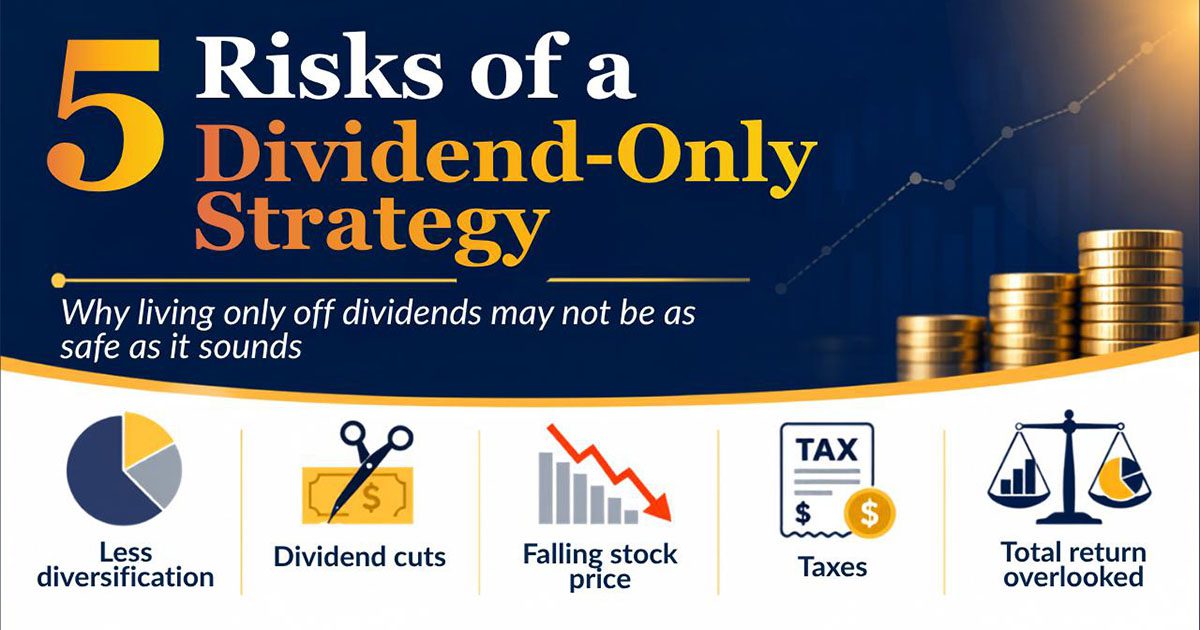
Here, “dividend” means a stock dividend, not a life insurance policy dividend. A stock dividend is a payment a company makes to shareholders from its profits. When the dividend is paid, the stock’s price generally drops by roughly the amount of that payment. The dividend is not free money added on top of the investment. It is a portion of the investment’s value being returned to the shareholder in cash.
Receiving a dividend can feel different from selling part of an investment, even though both affect what you own. Avoiding a sale does not necessarily mean the principal has been left untouched.
Dividend yield can also be misleading when viewed by itself. Yield compares the dividend amount with the stock’s price and expresses that relationship as a percentage. A higher yield can look attractive, but it does not automatically mean the investment is performing better. Sometimes the yield rises because the stock price has fallen.
Imagine one stock priced at $50 that pays a $5 dividend and another priced at $40 that pays an $8 dividend. The second stock has the higher yield, but the larger dividend does not tell the whole story. The stock’s value still matters. That is why total return — the dividend plus the change in the stock’s price — provides a more complete picture.
A dividend-only strategy can feel safe because the account balance is not intentionally being spent down. But retirement planning is about more than preserving the largest possible number on a statement. Savings are also meant to support a lifestyle and make an impact on the people and organizations that matter.