What to Consider Before Rolling Over a 401(k)

Rolling over a 401(k) can seem like a simple administrative task when you leave a job or retire.

Move the money, avoid a tax penalty, and keep everything invested. Those are important considerations, but they do not tell the whole story. Rolling over a 401(k) can also affect how much flexibility you have to make other financial and tax decisions in the years ahead.
For many people, saving into a retirement account has been the focus for decades. Taking money back out requires a different set of decisions. The order and timing of withdrawals can matter, especially during the years between leaving work and beginning other sources of retirement income.

That transition can create a valuable period of control. People who retire before starting Social Security or before Required Minimum Distributions begin may have several years with less taxable income than they had while working. If the 401(k) is moved automatically without looking at the larger picture, the rollover itself may be fine, but an opportunity around it can be overlooked.

Consider a composite example of a couple retiring at age 62. Their employer gives them an exit packet with an easy option: roll the 401(k) directly into an IRA at the same company that handled the workplace plan. They choose that option because it is straightforward and avoids creating a tax bill at the time of the rollover.

The bigger question is what their income will look like next.

Between age 62 and age 67, when they plan to begin Social Security, they have very little other taxable income. Those lower-income years could provide an opportunity to consider moving some money into a Roth IRA while they are in a lower tax bracket. If nobody looks at that window until several years later, some or all of that opportunity may already be gone.

Company stock can create another reason to slow down before automatically moving everything. If company stock is held inside the plan, special tax rules could apply and are worth reviewing before that stock is rolled into an IRA with the rest of the account.


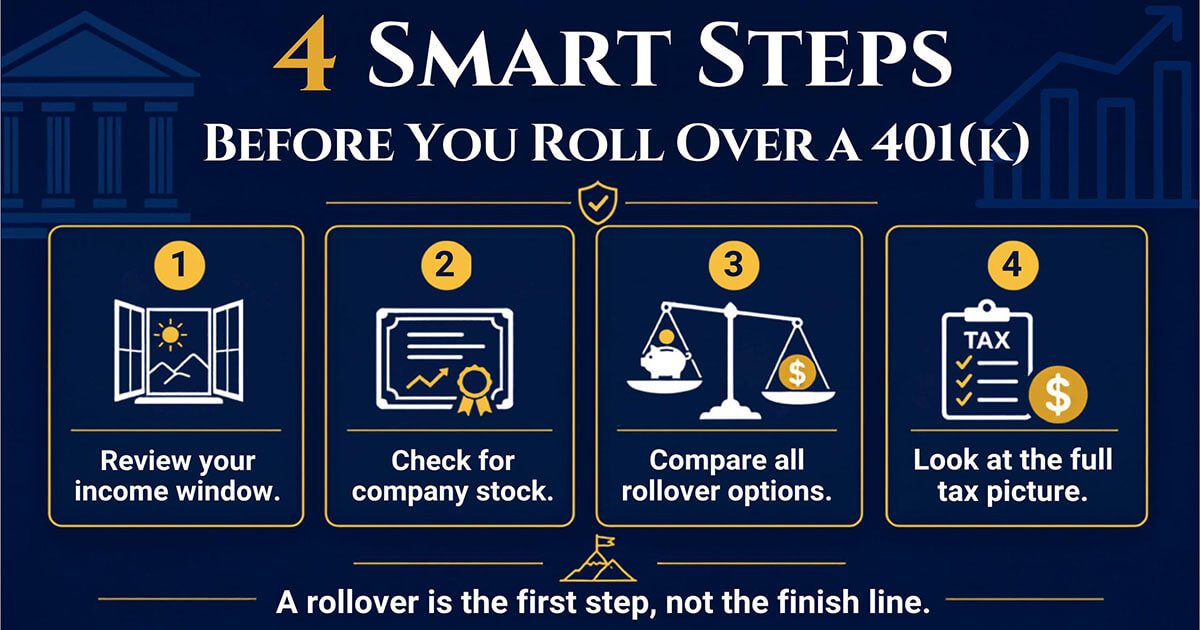
Before making a rollover decision, four questions are worth asking:

  • What will my income look like over the next few years, and could there be a lower-tax window worth considering?
  • Does my 401(k) hold company stock that should be reviewed for special tax rules before it is moved?
  • Have I compared the fees and choices involved in staying in the old plan, moving to a new employer plan, or rolling into an IRA?
  • Is the person helping with the rollover considering my broader tax picture, or simply processing the transaction?

When leaving a job, you have four basic choices. You may be able to leave the money in the former employer’s plan, move it into a new employer’s plan if that plan accepts it, roll it into an IRA, or cash it out. Cashing out comes with taxes and often a penalty, making it rarely the preferred choice. The amount of control, the fees, and the available choices can differ across the options.

The important point is that a rollover should not automatically be treated as the finish line. It is one part of a larger distribution plan. A decision that looks simple on a form may connect to income, taxes, company stock, fees, and the timing of future retirement income.

Taking time to understand those connections before moving the money can help ensure the rollover supports the years that follow rather than simply completing the paperwork in front of you.

Financial Enhancement Group is an SEC Registered Investment Advisor.

This content is for educational purposes only and is not intended to be financial, investment, or tax advice. Please consult with a qualified advisor regarding your specific situation.

Article Book Img

Get Your
Life-Change Checklists

Step-by-Step Guides for Confident Decisions

Icon Quote

“Give while it’s meaningful.
Give while you’re here.”

Article Book Img 02
Joseph Clark, CFP®

Managing Partner

Other Articles You Might Like

Stay Informed, Stay Confident

Whether you’re making day-to-day financial choices or preparing for major life transitions, these articles are here to help you navigate your journey with purpose.

We encourage you to share articles with family members, friends, or anyone who could benefit from tax-smart retirement strategies and clear, actionable advice.

Explore our latest financial planning articles below and take the next step toward living Your Life After Work™ with clarity and confidence.

Privacy Overview

This website uses cookies so that we can provide you with the best user experience possible. Cookie information is stored in your browser and performs functions such as recognising you when you return to our website and helping our team to understand which sections of the website you find most interesting and useful.