Estate Planning for Blended Families: Why Beneficiary Forms Matter

Estate planning for blended families requires more than having an updated will or trust.

A plan can look correct on paper and still produce an outcome that was never intended if the beneficiary designations on individual accounts do not match the rest of the estate plan. For families with children from previous marriages, that distinction can be especially important.
In a first marriage, people may assume assets will pass to a surviving spouse and eventually reach the children. A blended family might include his children, her children, children together, assets each spouse brought into the marriage, and different ideas about what is fair. That does not necessarily mean the estate plan needs to be more complicated. It does mean it should be more intentional.

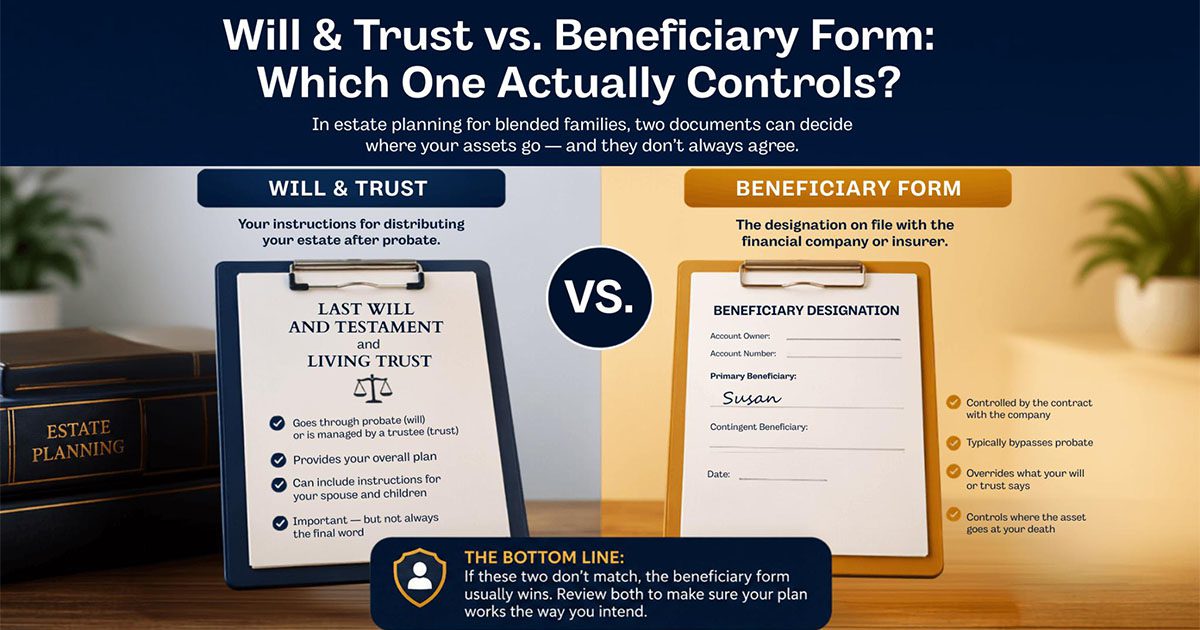
One place problems can arise is with accounts that pass according to a beneficiary designation. Retirement accounts and life insurance are common examples. These assets generally pass to the beneficiary listed on the form held by the company, rather than according to instructions in a will.

That can create a disconnect between what the estate documents say and what actually happens.

Consider John and Susan, who are married and each have children from a previous marriage. John wants Susan to be taken care of for the rest of her life, but he also wants a meaningful portion of what he built before their marriage to eventually reach his children. His will and trust reflect that intention.

But suppose his 401(k) and life insurance still have an old beneficiary listed, or they name Susan outright with no further instructions. Once Susan inherits those assets outright, they legally belong to her. She may spend them, remarry, or name new beneficiaries. John’s original intention no longer controls where those assets ultimately go. His children could receive nothing, even though neither John nor Susan intended that outcome.

The lesson is not that assets should never be left to a spouse. The larger point is that a good relationship and good intentions are not substitutes for a plan that actually protects the intended outcome.

Beneficiary forms also do not automatically change when life changes. A new marriage, divorce, new child, or a newly opened account can create a gap between the estate plan and the accounts themselves. People may update the major documents and assume everything else followed along, but that may not be the case.
A useful review should ask the following:

  • Who is currently listed as the beneficiary on each account?
  • Does that designation match what the will and trust are intended to accomplish?
  • If the primary beneficiary receives the asset outright, what happens to it afterward?
  • Have major family changes occurred since the beneficiary form was completed?
  • Have newer accounts been coordinated with the estate plan?

AARP research found that among Americans age 50 and older who have financial accounts, only 65% have named beneficiaries on those accounts. In other words, 35% are missing a beneficiary designation on at least one account. That makes reviewing the forms themselves an important part of the planning process.

The most useful question may be a simple one: If I died today, where does this account actually go, and do I have any say over what happens to it after that?

For blended families, estate planning is not about choosing between a spouse and children. It is about making sure the documents, accounts, and beneficiary forms work together so the plan reflects what the family actually intends.

Financial Enhancement Group is an SEC Registered Investment Advisor.

This content is for educational purposes only and is not intended to be financial, investment, or tax advice. Please consult with a qualified advisor regarding your specific situation.

Article Book Img

Get Your
Life-Change Checklists

Step-by-Step Guides for Confident Decisions

Icon Quote

“Give while it’s meaningful.
Give while you’re here.”

Article Book Img 02
Joseph Clark, CFP®

Managing Partner

Other Articles You Might Like

Stay Informed, Stay Confident

Whether you’re making day-to-day financial choices or preparing for major life transitions, these articles are here to help you navigate your journey with purpose.

We encourage you to share articles with family members, friends, or anyone who could benefit from tax-smart retirement strategies and clear, actionable advice.

Explore our latest financial planning articles below and take the next step toward living Your Life After Work™ with clarity and confidence.

Privacy Overview

This website uses cookies so that we can provide you with the best user experience possible. Cookie information is stored in your browser and performs functions such as recognising you when you return to our website and helping our team to understand which sections of the website you find most interesting and useful.