

If you watched the video above, you heard Daren Hardesty, CFP, Partner & Senior Advisor, and Aaron Rheaume, CKA, Partner & Director of Financial Planning, introduce one of the most important tools in legacy planning: the trust.

In their discussion, Daren explains what a trust is, why families use them, and how they can help simplify the transfer of assets after someone passes away.
In this article, we’ll expand on that conversation, covering:
- What a trust actually is
- How trusts differ from wills
- Why many families use revocable living trusts
- When a trust may (or may not) make sense for you
- Strategic planning considerations that can easily be overlooked
If you’re planning for retirement or thinking about estate planning, understanding how trusts work can be an important part of building a complete financial plan.
What Is a Trust?
At its simplest, a trust is a legal arrangement that holds assets and establishes rules for how those assets are managed and distributed.
As Daren explains:
“A trust is essentially when you decide, as the owner of property in your name, to move that property into an entity — in this case, a trust — where you’re no longer the official owner, but you become the trustee managing it.”
In other words, instead of owning assets personally, the trust becomes the legal owner. The person managing the trust — called the trustee — controls those assets according to rules defined in the trust document.
Those rules often specify:
- Who receives assets
- When they receive them
- Under what conditions distributions occur
Trusts are typically created as part of a broader estate planning strategy designed to manage assets during life and transfer them efficiently after death.
The Most Common Type: Revocable Living Trusts
There are many different types of trusts, but the most common for everyday estate planning is the revocable living trust.
Daren notes that this type of trust applies to most families in the middle of the financial spectrum:
“There are all kinds of different trusts… but for most of us in the middle, a revocable living trust is what we’re referring to.”
A revocable living trust allows you to:
- Maintain control of your assets while you’re alive
- Change or revoke the trust if your circumstances change
- Establish instructions for what happens after you pass away
This flexibility is one reason revocable trusts are widely used in estate planning.
The Key People Involved in a Trust
Every trust generally includes three roles:
Grantor (or Settlor)
The person who creates the trust and transfers assets into it.
Trustee
The person responsible for managing the trust assets and following the rules of the trust.
Beneficiaries
The people or organizations who ultimately receive the trust assets.
In many revocable living trusts, the same person may initially serve as both grantor and trustee, maintaining control of their assets during their lifetime.
How a Trust Works During Your Lifetime
Many people assume trusts only take effect after death. That’s not necessarily the case.
When you create a trust, you typically transfer ownership of certain assets into the trust while you’re alive. These may include:
- Real estate
- Brokerage accounts
- Non-retirement investments
- Life insurance proceeds
- Other valuable property
As trustee, you still manage these assets just as you did before.
The primary difference is that the trust document now governs how those assets will be handled in the future.
Why Many Families Use Trusts
Trusts can serve several purposes in estate planning. Here are some of the most common.
Avoiding Probate
One of the most frequently cited advantages of a trust is avoiding probate.
Probate is the legal process through which a court validates a will and supervises the distribution of assets after death.
Daren explains:
“Anything owned by your trust will avoid the probate process… a trustee can step in much more quickly and efficiently to distribute assets to beneficiaries.”
Probate can sometimes take months — or even longer — depending on the state and complexity of the estate.
Assets held in a trust can often pass to beneficiaries without going through probate court, which may help:
- Reduce delays
- Lower administrative costs
- Maintain privacy
Creating Clear Instructions for Asset Distribution
A trust allows you to set specific rules for how assets are distributed.
For example, you may decide:
- Children receive funds at certain ages
- Assets are distributed gradually over time
- Funds are used for education or healthcare
These instructions help ensure assets are managed according to your wishes.
Protecting Younger Beneficiaries
One common use of trusts involves minor children.
Without a trust, a child who inherits assets may gain full control at age 18.
As Daren mentions,
“Receiving a large amount of money at eighteen is probably a bad idea for most people.”
A trust allows parents to:
- Delay access to inheritance
- Distribute funds gradually
- Appoint a trustee to manage the assets responsibly
Addressing Different Needs Among Beneficiaries
Not all beneficiaries are in the same financial or life circumstances.
Some may be responsible with money. Others may face challenges.
A trust can account for these differences by allowing customized instructions for each beneficiary.
Daren points out that trusts can help families navigate complex situations:
“Not all beneficiaries are created equal… some may have financial issues, addiction challenges, or situations like divorce where protections may be helpful.”
Trust provisions can help protect assets while still supporting beneficiaries.
Trust vs. Will: What’s the Difference?
A common misconception is that a trust replaces a will.
In reality, they serve different roles.
|
Feature |
Will |
Trust |
|
Takes effect |
After death |
During life and after death |
|
Probate required |
Usually yes |
Usually avoided |
|
Privacy |
Public record |
Typically private |
|
Asset control |
Limited after death |
Can specify long-term rules |
Most comprehensive estate plans include both a will and a trust.
The will often covers assets not placed in the trust, while the trust governs the majority of estate transfers.
When a Trust Might Make Sense
While every situation is unique, trusts are commonly considered when someone has:
- A home or multiple properties
- Investment accounts outside retirement plans
- Minor children
- Blended family considerations
- A desire to avoid probate
- Concerns about how beneficiaries manage money
Daren emphasizes that trusts aren’t only for the wealthy:
“Some people think they don’t have enough money for a trust. I disagree. You know, I don’t have a whole lot of assets built up today, but I do have life insurance. I want to make sure that if something happens to my wife and me, I want to make sure my life insurance doesn’t go into a custodial account my kids can access as soon as they turn 18.”
Even families with modest assets may benefit from the structure and clarity a trust provides.
What This Means for You
If you’re thinking about your legacy or financial plan, trusts are worth understanding — but they aren’t a universal solution.
For some families, a will may be sufficient. For others, a trust can simplify future transitions and reduce stress for loved ones.
The key question is not just what you own, but how you want those assets handled when you’re no longer here.
Strategic Planning Considerations
Trusts interact with many parts of a financial plan. These are some of the planning areas worth evaluating carefully.
Asset Titling and Funding the Trust
Creating a trust is only the first step. Assets must actually be transferred into the trust.
Why this matters:
If assets remain outside the trust, they may still go through probate, defeating one of the trust’s main purposes.
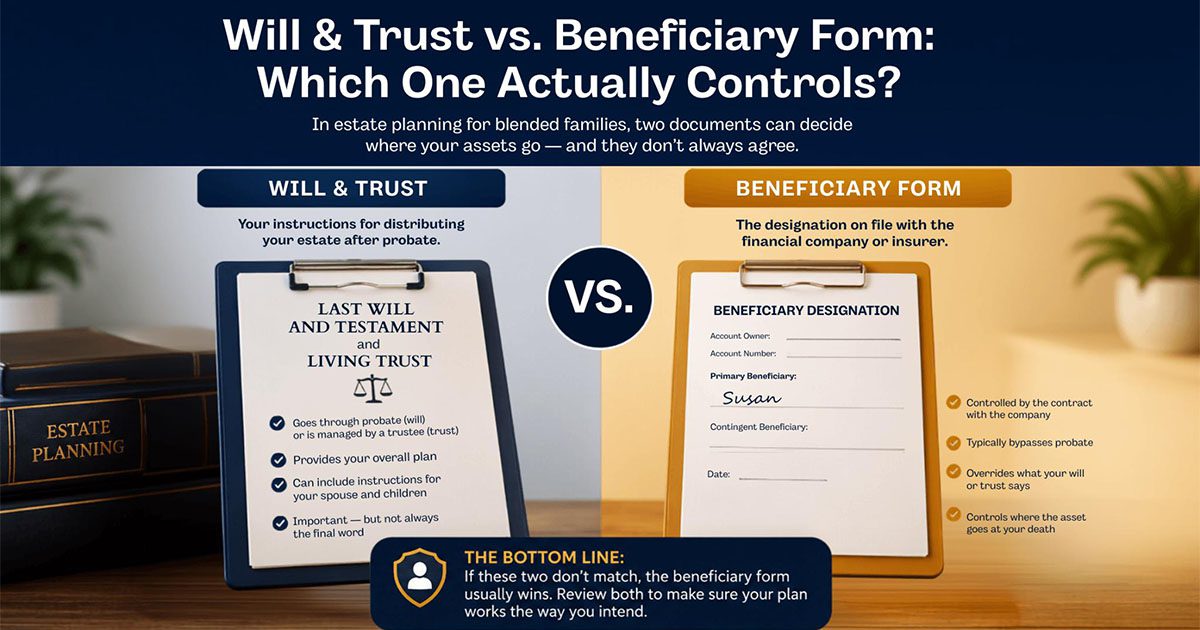
Beneficiary Designations
Some assets — like retirement accounts and life insurance — pass through beneficiary designations rather than a trust.
Why this matters:
Conflicts between beneficiary forms and trust instructions can create unintended outcomes if they aren’t coordinated.
Tax Planning and Retirement Accounts
Trusts can affect how retirement assets are distributed and taxed.
Why this matters:
Poorly structured trust planning could accelerate tax obligations for beneficiaries or limit their distribution options.
Family Dynamics
Estate plans can fail if they ignore interpersonal realities.
Why this matters:
Clear trust instructions can reduce conflict among heirs and create a smoother transition during an emotionally difficult time.
Ongoing Updates
Estate laws change, as do family situations, so financial plans must also evolve.
Why this matters:
A trust should be reviewed periodically to ensure it still reflects your goals and current laws.
Frequently Asked Questions About Trusts
What is a trust in simple terms?
A trust is a legal structure that holds assets and outlines how those assets are managed and distributed to beneficiaries.
What is the main purpose of a trust?
The primary purposes of a trust are managing assets, controlling how inheritance is distributed, and potentially avoiding probate.
What is a revocable living trust?
A revocable living trust is a flexible trust created during your lifetime that you can modify or revoke while you are alive.
Do trusts avoid probate?
Usually. Assets placed in a properly funded trust typically bypass the probate process.
Who controls a trust?
The trustee controls the trust assets and must follow the rules outlined in the trust document.
Do you still need a will if you have a trust?
Yes. Most estate plans include both a will and a trust to cover all assets and situations.
Are trusts only for wealthy people?
No. Many middle-income families use trusts to simplify estate administration and control how assets pass to heirs.
What assets can go into a trust?
Common assets placed in trusts include real estate, brokerage accounts, personal property, and sometimes life insurance proceeds.
Can a trust protect money from irresponsible spending?
Yes. Trusts can include rules that delay or control distributions to beneficiaries.
Can a trust be changed?
Revocable living trusts can usually be modified or revoked by the person who created them.
Planning Your Legacy With Confidence
Estate planning decisions have long-lasting ripple effects for your family.
A trust may help simplify the transfer of assets, provide structure for beneficiaries, and reduce administrative challenges after you’re gone, but it needs to be integrated thoughtfully with the rest of your financial plan.
If you’re approaching retirement or reviewing your legacy plan, a conversation with a fiduciary advisor can help clarify your options before decisions become irreversible.
At Financial Enhancement Group, we help families think through the financial, tax, and legacy implications of these choices so their plans support both their goals and their loved ones.
Financial Enhancement Group is an SEC Registered Investment Advisor. This information is provided for educational purposes only and should not be considered legal advice.